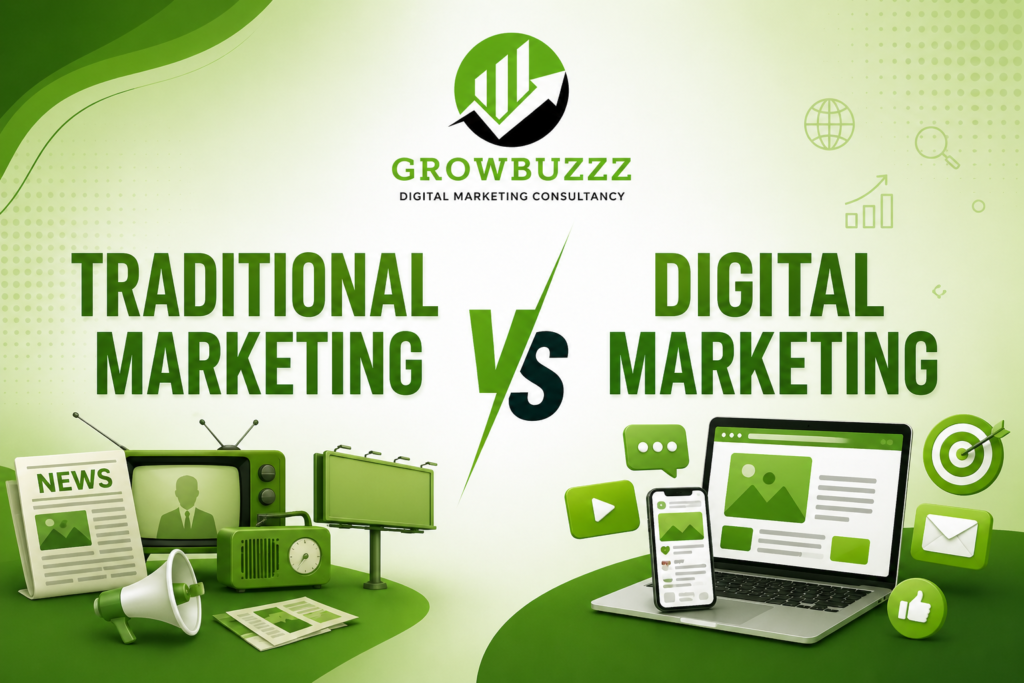
Marketing has evolved from print advertising, television advertising, and radio advertising to modern online marketing channels like SEO, social media, and paid ads. Businesses today must understand the difference between traditional marketing and digital marketing to choose the right strategy.
With over 6.04 billion internet users globally and digital marketing expected to reach $786 billion by 2026, the shift toward digital is clear. Traditional methods still hold value, but digital marketing offers better scalability, targeting, and ROI clarity.
What is Traditional Marketing?
Traditional marketing refers to offline marketing methods used before the internet era. These include print advertising, billboard advertising, broadcast media marketing, direct mail marketing, television advertising, and radio advertising.
These methods rely on mass communication medium, where brands broadcast messages to a broad audience. Traditional marketing builds strong brand recall value through visuals, jingles, and repeated exposure. However, it lacks precision and measurable performance tracking.
What is Digital Marketing?
Digital marketing uses online marketing channels such as Search Engine Optimisation, Pay Per Click Advertising, Social Media Marketing, Email Marketing, Content Marketing, and Video Marketing.
It focuses on two way communication marketing, where businesses interact with users through comments, messages, and engagement metrics. Digital marketing allows real time optimisation, performance based marketing, and targeted reach precision, making it more adaptable and scalable.
Traditional Marketing vs Digital Marketing (Comparison Table)
| Aspect | Traditional Marketing | Digital Marketing |
| Reach | Local or regional | Global + hyper local targeting |
| Cost | High (TV, print, radio) | Budget-friendly, scalable |
| Communication | One way communication | Two way communication |
| Targeting | Broad targeting | Behavioral & interest based advertising |
| Tracking | Limited measurement | Real-time performance tracking |
| Flexibility | Slow changes | Instant campaign adjustment |
| ROI Measurement | Estimated | Clear ROI measurement |
| Channels | TV, radio, billboards | SEO, PPC, social media |
| Audience | Older demographic targeting | Tech-savvy audience |
| Campaign Lifespan | Fixed, long-term | Adaptive campaigns |
Key Differences Explained (Deep Analysis)
Audience Reach and Targeting
Traditional marketing focuses on broad audiences using billboards or TV ads. It follows a spray and pray approach where messages reach many people but lack precision.
Digital marketing uses audience segmentation, demographic targeting, and psychographic targeting. Businesses reach users based on interests, behaviour, and location. This creates targeted advertising with better conversion potential.
Key Points:
- Broad vs hyper-targeted reach
- Location-based vs behavior-based targeting
- Limited vs precise audience selection
Digital marketing improves efficiency by focusing only on relevant users.
Cost and Marketing Budget Allocation
Traditional marketing requires high investment in broadcast media marketing and print campaigns. Small businesses often struggle due to limited budgets.
Digital marketing offers budget friendly campaigns with flexible spending. Businesses can start small and scale based on results.
Cost Benefits of Digital Marketing:
- Scalable marketing costs
- Better budget control
- Lower cost per lead
This makes digital marketing ideal for startups and small businesses in India.
Communication and Customer Interaction
Traditional marketing is mostly one way communication. Brands send messages, but customers cannot interact directly.
Digital marketing enables customer interaction online through comments, emails, and social platforms. This builds brand loyalty and engagement metrics.
Engagement Channels:
- Social media interaction
- Email communication
- Live chat and feedback
Two-way communication improves customer relationships and trust.
Performance Tracking and Analytics
Traditional marketing lacks accurate campaign reach measurement. Businesses rely on estimates and surveys.
Digital marketing provides real time data, click through rate, and engagement metrics. Tools like Google Analytics allow detailed tracking.
Trackable Metrics:
- Traffic and impressions
- Conversion rate
- ROI measurement
This enables data driven strategy and campaign optimisation.
Flexibility and Campaign Adaptability
Traditional campaigns have fixed schedules. Changes require time and additional cost.
Digital marketing offers instant campaign adjustment and marketing adaptability. Businesses can modify ads, creatives, and targeting instantly.
Advantages:
- Real time optimisation
- Adaptive campaigns
- Quick experimentation
This flexibility improves performance and reduces losses.
ROI and Performance-Based Marketing
Traditional marketing focuses on impression based marketing. Businesses cannot measure exact returns.
Digital marketing provides marketing ROI clarity through performance-based models. For example, email marketing generates $36–$40 ROI per $1 spent.
This makes digital marketing more efficient and result-oriented.
Marketing Scalability and Growth
Traditional marketing has limited scalability due to cost and reach restrictions.
Digital marketing offers marketing scalability and global local duality. Businesses can scale campaigns globally while targeting local audiences.
Growth Benefits:
- Expand to global markets
- Maintain local relevance
- Increase share of voice
This helps businesses grow faster in competitive markets.
Real-Life Examples
Example 1: Local Business
A local shop using billboard advertising may reach thousands, but only a few convert. Using Local SEO and Google Ads, the same business can target users searching “near me” and generate direct leads.
Example 2: E-commerce Brand
An e-commerce brand using TV ads cannot track conversions accurately. With Meta Ads and retargeting, businesses can track user behaviour and improve conversions.
Can Traditional and Digital Marketing Work Together?
Yes. Businesses can use an integrated marketing strategy combining both approaches.
Best Hybrid Use Cases:
- Product launch: Digital awareness + offline branding
- Festive campaigns: Social media + billboard advertising
- Events: Broadcast media + digital engagement
This approach improves reach and customer journey mapping.
Digital Marketing in India (2026 Insight)
India has rapidly adopted digital platforms. Businesses now prefer digital marketing because it offers:
- Targeted reach for local audiences
- Affordable campaigns
- Measurable results
This makes digital marketing the future for Indian businesses.
Conclusion
The difference between traditional marketing and digital marketing lies in targeting, cost, scalability, and performance tracking.
Traditional marketing builds brand awareness and credibility, while digital marketing delivers measurable results, targeted reach, and higher ROI.
The best strategy is not choosing one over the other but using both effectively based on business goals.
FAQs (Voice Search Optimized)
What is the main difference between traditional and digital marketing?
Traditional marketing uses offline channels, while digital marketing uses online platforms with real-time tracking and targeting.
Which is more effective traditional or digital marketing?
Digital marketing is more effective due to targeted reach, measurable results, and cost efficiency.
Is traditional marketing still relevant in 2026?
Yes, it works for local branding and older audiences but is less flexible than digital marketing.
Which marketing has better ROI?
Digital marketing provides better ROI due to performance tracking and optimization.
Can both marketing strategies work together?
Yes, combining both creates a strong omnichannel marketing strategy.